CanWell was Invited to Present at 9th Immuno-oncology 360° (IO360°) Conference

CanWell presented the preclinical research results of CAN1012, a small molecule TLR7 agonist in the form of an oral presentation at the 9th Immuno-oncology 360° (IO360°) conference.

The IO360° conference is a globally renowned annual conference for cancer immunotherapy, providing a collaboration opportunity for pharmaceutical/biotech companies, academia, and investors. The conference offers the platform where the latest progresses of cancer immunotherapy are shared and exchanged.

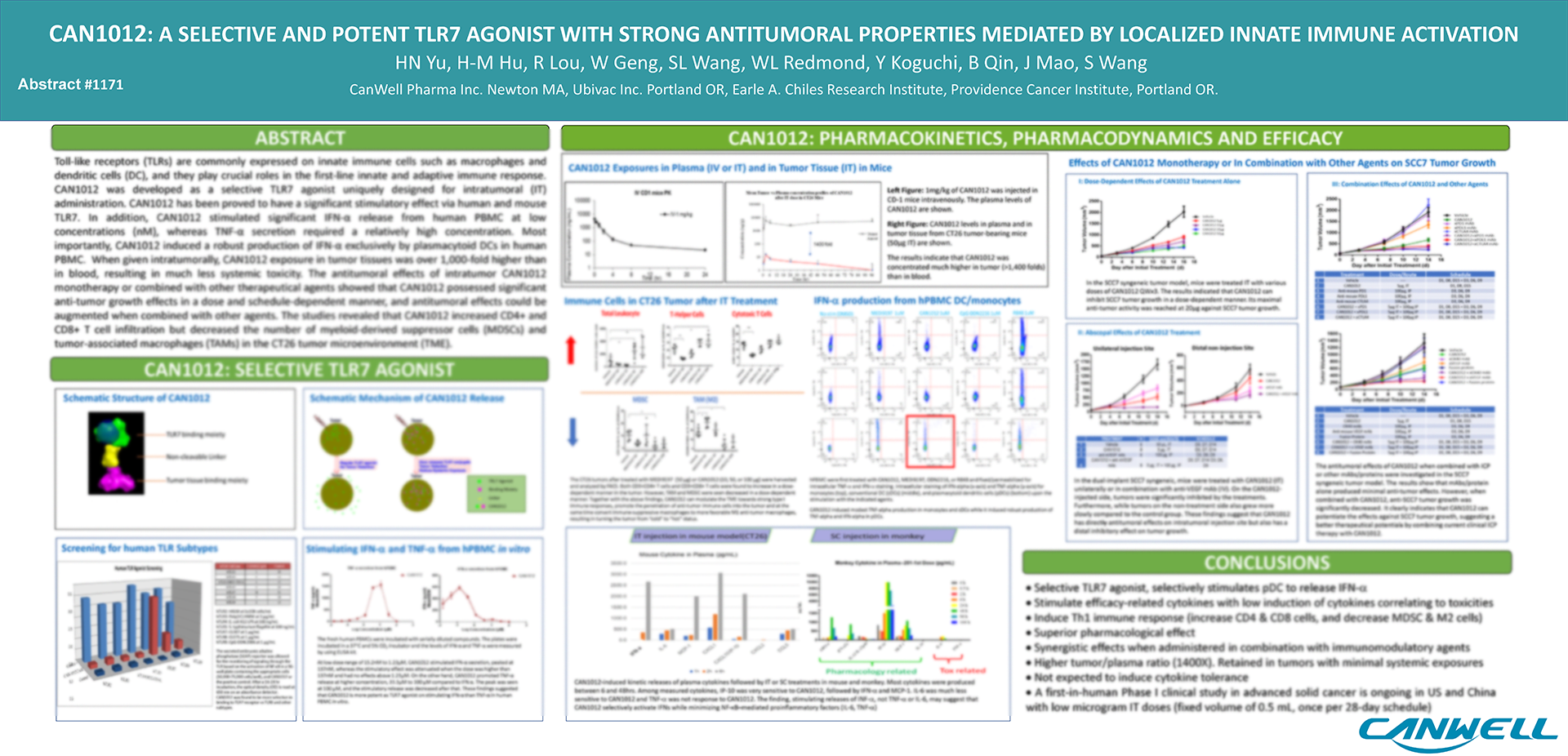
CanWell presented the preclinical research results of CAN1012 at the annual meeting of the Society for Immunotherapy of Tumors (SITC)

CanWell announced today that the preclinical results of its small molecule TLR7 agonist CAN1012 were presented at the 37th Annual Meeting of the Society for Immunotherapy of Tumors (SITC 2022, Boston).

Abstract ID: #1171

Poster title: CAN1012: A SELECTIVE AND POTENT TLR7 AGONIST WITH STRONG ANTITUMORAL PROPERTIES MEDIATED BY LOCALIZED INNATE IMMUNE ACTIVATION

Time: November 8-12, 2022. Boston US

CAN1012 is a slow-release selective TLR7 receptor agonist exclusively developed by CanWell with global intellectual property rights. Preclinical studies have shown that CAN1012 has high selectivity and activities with low toxicities.  It continuously stimulates the target immune cells in the tumor microenvironment, releasing a variety of cytokines/chemokines related to drug efficacy, thereby promoting the activation of anti-tumor immune cells and their infiltration into the tumor, transforming the “cold” tumor with a low immune response into a “hot” tumor with a strong immune response. When CAN1012 is used as a single agent in various preclinical tumor models, it has shown robust anti-tumor activities, while exhibiting extremely low systemic exposure. In addition, CAN1012 can be combined with a variety of tumor immune checkpoint inhibitors, targeted therapy drugs or chemotherapy to produce stronger anti-tumor activities.

CAN1012 is currently in clinical Ph I development  in China and the United States. In June 2021, it obtained IND approval from the US FDA and entered phase I clinical trial (NCT04987112) in the US. In July 2022, it received IND clearance from the Chinese CDE (JXHL2200119). A multi-center phase I clinical trial is currently ongoing in China.

First patient dosed in CanWell’s CAN1012 Ph1 Trial in China

CanWell Biotech Ltd. , a company specializing in the development of innovative immune-oncology drugs, announced today that the 1st patient has been successfully dosed in its ongoing CAN1012 Ph1 clinical trial in China.

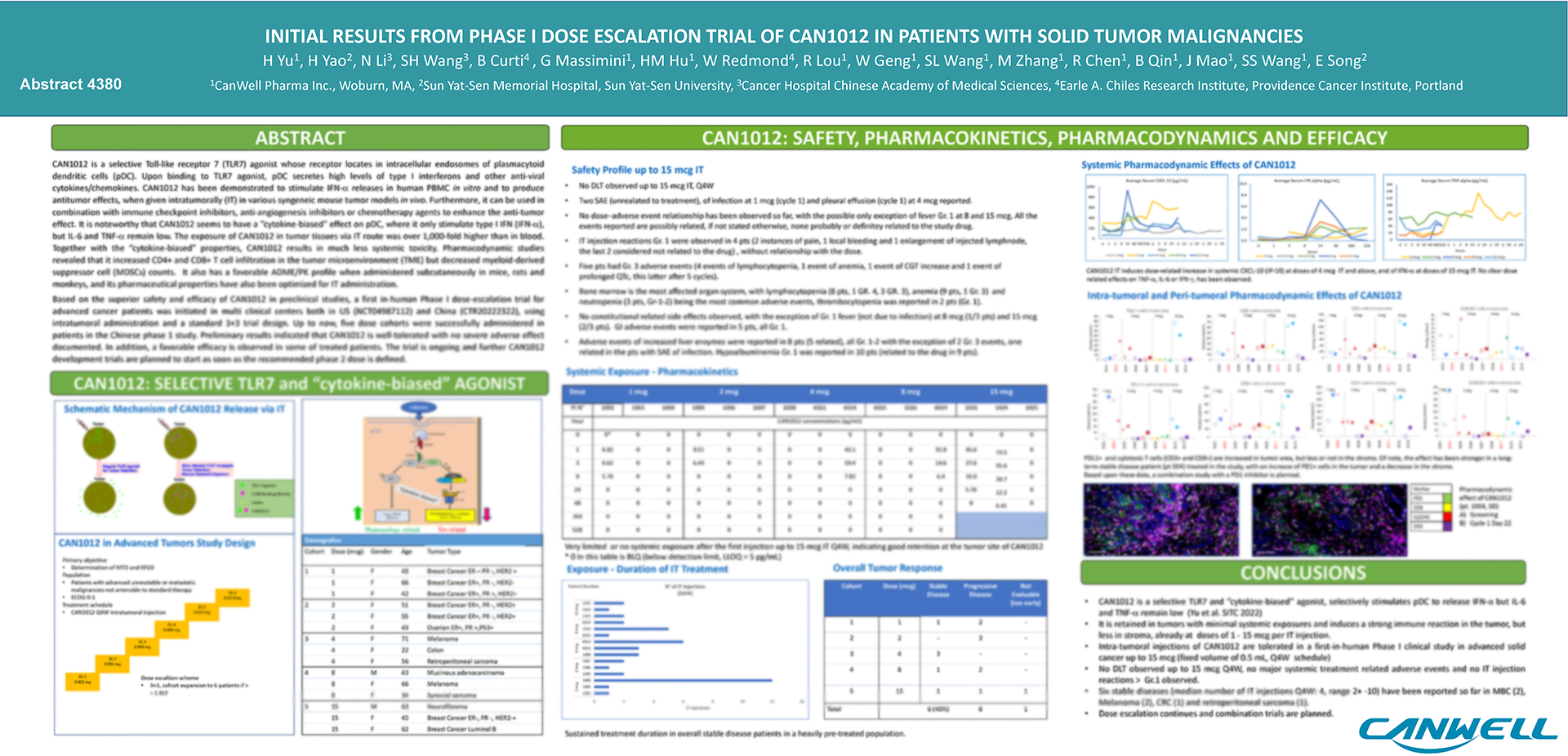
The CAN1012 Phase I clinical trial is an open-label, multicenter, dose-escalation, and dose-expansion study aimed at evaluating the safety, tolerability, and preliminary efficacy of the drug in late-stage solid tumor patients as a single agent, and determining the maximum tolerated dose and recommended Phase II dose. Currently, the study is being conducted simultaneously in China and the United States.

CAN1012 is a highly selective small-molecule TLR7 agonist developed by CanWell with global intellectual property rights. Preclinical studies have shown that it has high selectivity and potency, with low toxicities. It can exert sustained stimulation of the target cells in the tumor microenvironment, transforming “cold” tumors with low immune response into “hot” tumors with augmented immune response, playing a crucial bridging role in the innate and adaptive immune systems. In addition, it may be administered in combination with various drugs such as immunotherapy checkpoint inhibitors, as well as radiotherapy and chemotherapy, to produce highly synergistic effects.

CanWell’s TLR7 Agonist CAN1012 Received IND Approval by CDE in China

Canwell announced today that its TLR7 agonist CAN1012 had obtained clinical trial approval from China’s Center for Drug Evaluation (CDE). The approval allows CanWell to conduct Phase I clinical trials targeting advanced solid tumors in China. Prior to this, CAN1012 had obtained Phase I clinical trial approval from the US Food and Drug Administration (FDA) and Phase I clinical trial in the US is currently ongoing.

The CAN1012 Phase I clinical trial is an open-label, multicenter, dose-escalation, and dose-expansion study aimed at evaluating the safety, tolerability, and preliminary efficacy of the drug in late-stage solid tumor patients as a single agent, and determining the maximum tolerated dose and recommended Phase II dose. Currently, the study is being conducted simultaneously in China and the United States.

CAN1012 is a highly selective small-molecule TLR7 agonist developed by CanWell with global intellectual property rights. Preclinical studies have shown that it has high selectivity and potency, with low toxicities. It can exert sustained stimulation of the target cells in the tumor microenvironment, transforming “cold” tumors with low immune response into “hot” tumors with augmented immune response, playing a crucial bridging role in the innate and adaptive immune systems. In addition, it may be administered in combination with various drugs such as immunotherapy checkpoint inhibitors, as well as radiotherapy and chemotherapy, to produce highly synergistic effects.

CanWell’s TLR7 Agonist CAN1012 IND Granted Approval by US FDA

CanWell Pharma announced that its First-in-Class innovative drug, TLR7 agonist CAN1012, has been granted clinical approval by the US Food and Drug Administration (FDA) and will soon conduct Phase I clinical trials for various solid tumors.

CAN1012 is an innovative Toll-like receptor (TLR) 7 small molecule agonist independently developed by CanWell with global intellectual property rights. It is a sustained-release injection with high selectivity, high activity, and excellent physicochemical characteristics. Through sustained stimulation in the tumor microenvironment, CAN1012 can transform non-immune responsive “cold” tumors into immune responsive “hot” tumors, playing a crucial bridging role in both innate and adaptive immune systems, and enabling the body’s own immune system to recognize and attack tumor cells. In addition, it has a strong potential synergistic effect with various anti-cancer therapies, such as tumor immunotherapy checkpoint inhibitors. By locally releasing the drug, CAN1012 can effectively reduce adverse reactions caused by systemic immune system activation, making the drug safer and more effective.

Professor Qiang Pan-Hammarström Named Member of Scientific Advisory Board at CanWell

CanWell announced today that Professor Qiang Pan-Hammarström has joined the Scientific Advisory Board (SAB) at CanWell. Professor Pan-Hammarström is a leading researcher in studying the genetic mechanisms and treatment of primary immunodeficiency diseases, including B cell development, immunoglobulin gene diversity, the pathogenesis of B-cell lymphoma, and related immunotherapies. She is currently the Professor of Clinical Immunology at Karolinska Institute and the elected member of Nobel Assembly.

Professor Pan-Hammarström previously served as a visiting professor at Peking University, Sun Yat-sen University, and Rockefeller University in the United States, as well as a visiting scholar at Braeburn College and a visiting professor at Tianjin Medical University. She is currently a member of the scientific advisory committee of the KG Jebsen B-Cell Malignancy Research Center at the University of Oslo.  She also serves as an editor for Clinical Immunology, Frontiers in Immunology, and other journals, and has served as a committee member for the Swedish Research Council and the Swedish Cancer Society.

CanWell submits to US FDA the Investigational New Drug (IND) for its TLR7 agonist CAN1012 for Cancer Treatment

CanWell Pharma announced today that its independently developed First-in-Class innovative drug, TLR7 agonist, was submitted to the US Food and Drug Administration (FDA) for Investigational New Drug (IND) application and was accepted for review.

CAN1012 is an innovative Toll-like receptor (TLR) 7 small molecule agonist independently developed by CanWell with global intellectual property rights. It is a sustained-release injection with high selectivity, high activity, and excellent physicochemical characteristics. Through sustained stimulation in the tumor microenvironment, CAN1012 can transform non-immune responsive “cold” tumors into immune responsive “hot” tumors, playing a crucial bridging role in both innate and adaptive immune systems, and enabling the body’s own immune system to recognize and attack tumor cells. In addition, it has a strong potential synergistic effect with various anti-cancer therapies, such as tumor immunotherapy checkpoint inhibitors. By locally releasing the drug, CAN1012 can effectively reduce adverse reactions caused by systemic immune system activation, making the drug safer and more effective.

Dr. Bernard A. Fox Appointed the Member of Scientific Advisory Committee of CanWell

CanWell announced today that Dr. Bernard A. Fox is appointed as the Advisor of CanWell’s Scientific Advisory Committee (SAC). Dr. Fox is a leading researcher in the field of cancer immunotherapy and currently serves as the Chief and Director of the Molecular and Tumor Immunology Laboratory at the Earle A. Chiles Research Institute and the Providence Cancer Center. He is also an Associate Professor in the Department of Molecular and Immunology at the Oregon Health and Science University and a member of the Tumor Immunology Group at the OHSU Knight Cancer Institute. Dr. Fox is the founder and CEO of UbiVac, a clinical-stage immunotherapy biotech company.

Dr. Fox is currently the President of the World Immunotherapy Council (WIC), an association composed of a large number of international cancer immunotherapy organizations in 22 countries. He has also served as the former President of the Society for Immunotherapy of Cancer (SITC) and a member of the National Cancer Institute (NCI), National Institutes of Health (NIH), and Cell, Tissue and Gene Therapy Advisory Committee (CBER) at the US Food and Drug Administration (FDA). Dr. Fox has more than 30 years of experience in cancer immunotherapy and is recognized as a pioneer in this field. He has served as a scientific advisor to numerous well-known pharmaceutical companies, including AstraZeneca, BMS, Cell Genesys, Dendreon, Merck Serono, J&J, Mannkind, Micromet, Novartis, PerkinElmer, and Pfizer.

CanWell, Sun Yat-sen Memorial Hospital of Sun Yat-sen University and UbiVac Jointly Held a Clinical Seminar on Cancer Vaccine DPV-001

Sun Yat-sen Memorial Hospital of Sun Yat-sen University, together with CanWell and UbiVac, Inc., successfully held the First-in-Class International Symposium on Clinical Trials of Cancer Vaccine DPV-001 Vaccine.

CanWell has obtained the exclusive license of UbiVac immunotherapy cancer vaccine DPV-001 in Greater China, and will carry out multi-center clinical research.  Sun Yat-sen Memorial Hospital of Sun Yat-sen University is expected to conduct potential clinical trials. The meeting focused on the drug mechanism of DPV-001, pre-clinical data, clinical needs of China and the United States, standard medical care, racial differences, patient enrollment, drug safety, and potential drug combination therapies.

About UbiVac

UbiVac is a US privately held, clinical stage immunotherapy company engaged in the research and development of therapeutic vaccines and adoptive cellular therapies to combat cancer. With innovative, first-in-class platform technology that couples an off-the-shelf DC-targeted cancer vaccine with more than 100 cancer antigens for most adenocarcinomas and squamous cell cancers, UbiVac’s cancer vaccine DPV-001 is highly complementary to current and developing drugs in the markets. UbiVac also has a pipeline of vaccines and cell therapies under development to target advanced cancers, COVID-19, and to prevent cancer in patients at high risk of developing disease.  Founded by Dr. Bernard A. Fox, Dr. Hong-Ming Hu, and Mr. Bernard A. Fox, III, UbiVac is a spin-out of the Robert W. Franz Cancer Center, Earle A. Chiles Research Institute at Providence Portland Medical Center.

About DPV-001

DPV-001 is a dendritic cell-targeted microvesicle containing short-lived proteins that are thought to represent the dominant HLA-presented epitopes on the surface of cancer cells.  These microvesicles are packaged with multiple TLR and NOD agonists, together with 15 DAMPs and chaperones. The microvesicle vaccine also contains more than 100 proteins that are overexpressed by the average breast cancer, head and neck cancer and non-small cell lung cancer, and as many as 1700 altered peptide ligands that can augment immunity against cancer antigens. Together this formulation drives B cells, CD4 and CD8 T cells, as well as innate components of the host’s immune system, to mediate anticancer function.

In preclinical models this vaccine can convert tumors that are considered “cold” because they lack immune cells into tumors that are “hot” with cancer killer cells. This is important as many human tumors are thought to be unresponsive to immunotherapy because they lack immune cells capable of recognizing their cancer and are considered to be “cold” tumors. UbiVac and its partners are currently conducting ph1b/II clinical studies in the US for the treatment of several major solid tumors.

CanWell and UbiVac Announce Exclusive License Agreement For Cancer Vaccine DPV-001 in Greater China

CanWell Pharma Inc., a leading venture-backed biopharmaceutical company developing innovative immunotherapies for cancer, and UbiVac, Inc., a US clinical stage immunotherapy company, today announced an exclusive license agreement to develop and commercialize UbiVac’s first-in-class cancer vaccine DPV-001 to treat cancers in Greater China.

Under the agreement, CanWell is responsible for development and commercialization of DPV-001 in Head and Neck, Breast, and Non-Small Cell Lung Cancers in Greater China. UbiVac is responsible for manufacturing and product supply. UbiVac is entitled to receive upfront and milestone payments and royalties.

DPV-001 is a first-in-class cancer vaccine that exploits autophagy to educate the immune system to destroy cancer cells. When used in combination with other immunotherapies such as immune checkpoint inhibitors and T cell agonists, DPV-001 significantly augments anticancer immunity in preclinical models. DPV-001 is currently being evaluated in two US clinical Ph1b/PhII studies by UbiVac and its collaborators, for the safety, tolerability, and preliminary efficacy in patients with advanced tumors.

About UbiVac

UbiVac is a US privately held, clinical stage immunotherapy company engaged in the research and development of therapeutic vaccines and adoptive cellular therapies to combat cancer. With innovative, first-in-class platform technology that couples an off-the-shelf DC-targeted cancer vaccine with more than 100 cancer antigens for most adenocarcinomas and squamous cell cancers, UbiVac’s cancer vaccine DPV-001 is highly complementary to current and developing drugs in the markets. UbiVac also has a pipeline of vaccines and cell therapies under development to target advanced cancers, COVID-19, and to prevent cancer in patients at high risk of developing disease. Founded by Dr. Bernard A. Fox, Dr. Hong-Ming Hu, and Mr. Bernard A. Fox, III, UbiVac is a spin-out of the Robert W. Franz Cancer Center, Earle A. Chiles Research Institute at Providence Portland Medical Center.

About UbiVac’s DPV-001

DPV-001 is a dendritic cell-targeted microvesicle containing short-lived proteins that are thought to represent the dominant HLA-presented epitopes on the surface of cancer cells. These microvesicles are packaged with multiple TLR and NOD agonists, together with 15 DAMPs and chaperones. The microvesicle vaccine also contains more than 100 proteins that are overexpressed by the average breast cancer, head and neck cancer and non-small cell lung cancer, and as many as 1700 altered peptide ligands that can augment immunity against cancer antigens. Together this formulation drives B cells, CD4 and CD8 T cells, as well as innate components of the host’s immune system, to mediate anticancer function.

In preclinical models this vaccine can convert tumors that are considered “cold” because they lack immune cells into tumors that are “hot” with cancer killer cells. This is important as many human tumors are thought to be unresponsive to immunotherapy because they lack immune cells capable of recognizing their cancer and are considered to be “cold” tumors. UbiVac and its partners are currently conducting ph1b/II clinical studies in the US for the treatment of several major solid tumors.

Contact:

CanWell Pharma Inc.

henry@canwellpharma.com